Padel Racket Shapes Explained: Round vs Teardrop vs Diamond
Walk into any UK padel club and you'll hear players talking about weight, carbon layers and brand loyalty — but the single spec that changes how a racket feels in your hand is shape. Padel racket shapes determine where the sweet spot sits, how forgiving the frame is on mishits, and how much effort you need to put into a smash. Get the shape wrong and even a £200 frame will feel awkward. Get it right and a £60 racket will flatter your game every week.
In this guide we explain the three padel racket shapes — round, teardrop and diamond — what each one actually does on court, and how to match a shape to your level. We'll also cover the specs that work alongside shape, and finish with five in-stock recommendations from the padel range here at Central Sports.
Why padel racket shapes matter more than the paint job
Padel rackets are solid frames with a perforated face, so unlike tennis there's no string bed to soften the hit. All the forgiveness has to come from the frame's geometry and the foam core inside it. Shape controls the balance point, and the balance point controls where the sweet spot sits on the face. The lower and more central that sweet spot, the easier the racket is to use; the higher up the face it sits, the more power you can generate but the smaller and less forgiving it becomes. Every padel racket shape is a different compromise between those two facts.
This matters more in the UK than you might think. Most British padel is played on indoor or covered courts with slightly slower balls, in doubles, at club pace. That format rewards consistency, volleying and long rallies far more than it rewards raw smashing power — which is why so many UK players buy the wrong shape after watching World Padel Tour highlights.
Round padel rackets: control, forgiveness and the biggest sweet spot
A round racket has its widest point in the middle of the face and a low, centred balance. That puts the sweet spot dead in the middle of the head, right where beginners and improving players naturally make contact. The result is a frame that feels light in the hand, easy to swing late, and remarkably forgiving when you catch the ball slightly off-centre.
Round frames excel at the things that actually win club matches: blocking, low volleys at the net, controlled lobs, and getting the ball back off the back glass. They're also the kindest shape on your elbow and shoulder, because you're not swinging a head-heavy frame through every rally.
The trade-off is ceiling. A round racket won't give you a flat, unreturnable smash — you have to generate that pace yourself. For roughly 70% of UK players, that's a trade worth making. If you're in your first two years of padel, play mostly doubles, or you're coming from tennis and want something that behaves predictably, a round frame is the right buy.
Teardrop padel rackets: the all-rounder most UK club players should buy
The teardrop shape sits between round and diamond. Its widest point is slightly above centre, which pushes the balance a little higher and moves the sweet spot up the face. You keep a good chunk of the round frame's forgiveness while gaining noticeably more punch on volleys and overheads.
This is the shape that suits improving club players best. Once you can reliably control the ball off the glass and you're starting to attack short lobs, a teardrop gives you the extra bite without punishing you every time your timing slips. Manufacturers know this — teardrop is by far the biggest category in most 2026 ranges, and it's where the strongest value sits.
If you're playing weekly, competing in a club box league, and you already have a repeatable technique, a teardrop is very likely your racket. It's also the safest choice if you genuinely aren't sure which of the padel racket shapes suits you, because it fails gracefully in both directions.
Diamond padel rackets: power for players who already have technique
A diamond racket has its widest point near the top of the head, which shifts the balance high and concentrates the sweet spot in the upper third of the face. Hit it cleanly and the ball leaves with serious pace — a diamond frame is what you want for the flat smash and the bandeja played with intent.
The catch is that the sweet spot is small and the frame is head-heavy. Miss the middle and you'll feel it in your wrist and elbow, and the ball will die. Diamond rackets also demand more from your shoulder over a long match, which is why we'd steer anyone with a history of arm trouble towards a teardrop with a soft core instead.
Buy a diamond only if you're an advanced player with consistent contact, you finish points at the net, and you're playing enough to keep your technique sharp. If you're buying one because it looks like what the pros use, you'll almost certainly play worse than you would with a teardrop.
How to match a padel racket shape to your level
- Complete beginner or first racket: round shape, 355–365g, soft EVA core. Prioritise forgiveness over everything.
- Improving club player (1–3 years): round or teardrop, 360–370g, soft to medium core. Teardrop if you're already attacking.
- Strong club / league player: teardrop, 365–375g, medium core. The best all-round performance category.
- Advanced / competitive: teardrop or diamond, 370–380g, medium to hard core, depending on whether you value control or finishing power.
- Any player with elbow or shoulder issues: round or teardrop with a soft EVA core, and keep the weight under 365g.
One more note for UK buyers: soft and medium EVA cores hold their liveliness better through a cold British winter than hard cores do. If you play in an unheated covered venue from October onwards, that's a real consideration, not marketing.
Weight, balance and core — the specs that work alongside shape
Shape sets the character of a racket, but three other specs decide whether you'll actually enjoy it. Weight is the first: most adult padel rackets sit between 350g and 385g, and anything above 375g will feel heavy by the third set unless you're strong and well conditioned. Lighter frames are quicker at the net; heavier frames are more stable against pace.
Balance is measured from the handle and works with shape rather than against it — a low-balance teardrop feels far more manageable than a high-balance one, even though both are "teardrop". Then there's the core. Soft EVA absorbs more shock and gives a longer dwell time, which means more control and a friendlier feel on the arm. Hard EVA returns more energy for players who swing fast enough to compress it. Most UK club players are better served by soft or medium. You can compare all of these specs across our collections, or explore our collections to see how each brand builds its ranges.
Top padel racket picks from Central Sports
These five frames are all in stock now at centralsports.co.uk and cover every shape and budget discussed above.
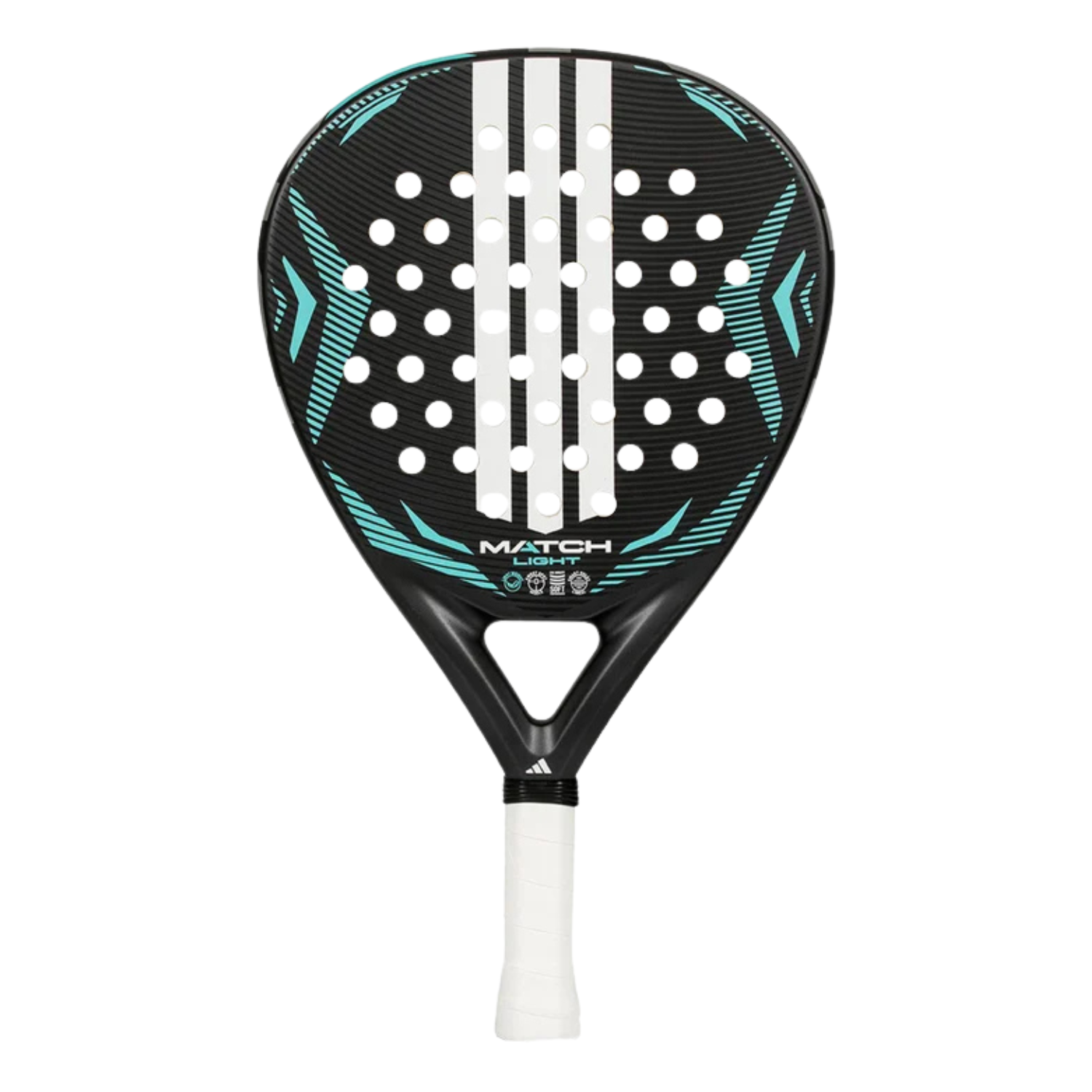
- Adidas Match Light 2026 Padel Racket – Anthracite/Blue (£55.58) — a genuinely light round frame and our pick for a first racket. Maximum forgiveness, easy to swing, and priced so you can get on court without overthinking it.
- BullPadel Open Control Padel Racket – Grey (£60.80) — the classic round control frame. If your game is built on blocking, lobbing and keeping the ball in play, this is the shape doing exactly what it's designed for.
- Wilson Optix V2 Power 2026 Padel Racket – Blue (£87.40) — a well-judged teardrop for the improving club player. Enough punch on the volley to finish points, enough sweet spot to survive a scrappy rally.
- BullPadel Vertex Advance 26 Padel Racket – Black/Orange (£113.99) — Bullpadel's power lineage in a more accessible build. A strong step up if you've outgrown a round frame and want real bite on the smash.
- Adidas Metalbone Carbon CTRL 2026 Padel Racket – White/Black (£171.00) — the advanced pick. Diamond-family power with a control bias, for players who already find the middle of the face consistently.
Not sure which to commit to? See all products or browse our racket sports shop and filter by brand and price to narrow things down.
Choosing your next padel racket with confidence
Padel racket shapes aren't marketing categories — they're the clearest signal you have about how a frame will behave on a UK club court. Round for forgiveness and control, teardrop for the best all-round balance, diamond for power you've already earned through technique. Be honest about your level, buy one shape below your ego, and you'll see the difference in your very next session.
Every racket listed above is in stock and ready to ship from Central Sports, with UK delivery and a team of players who actually use this kit. Browse the full padel racket range at centralsports.co.uk and get the shape right first time.