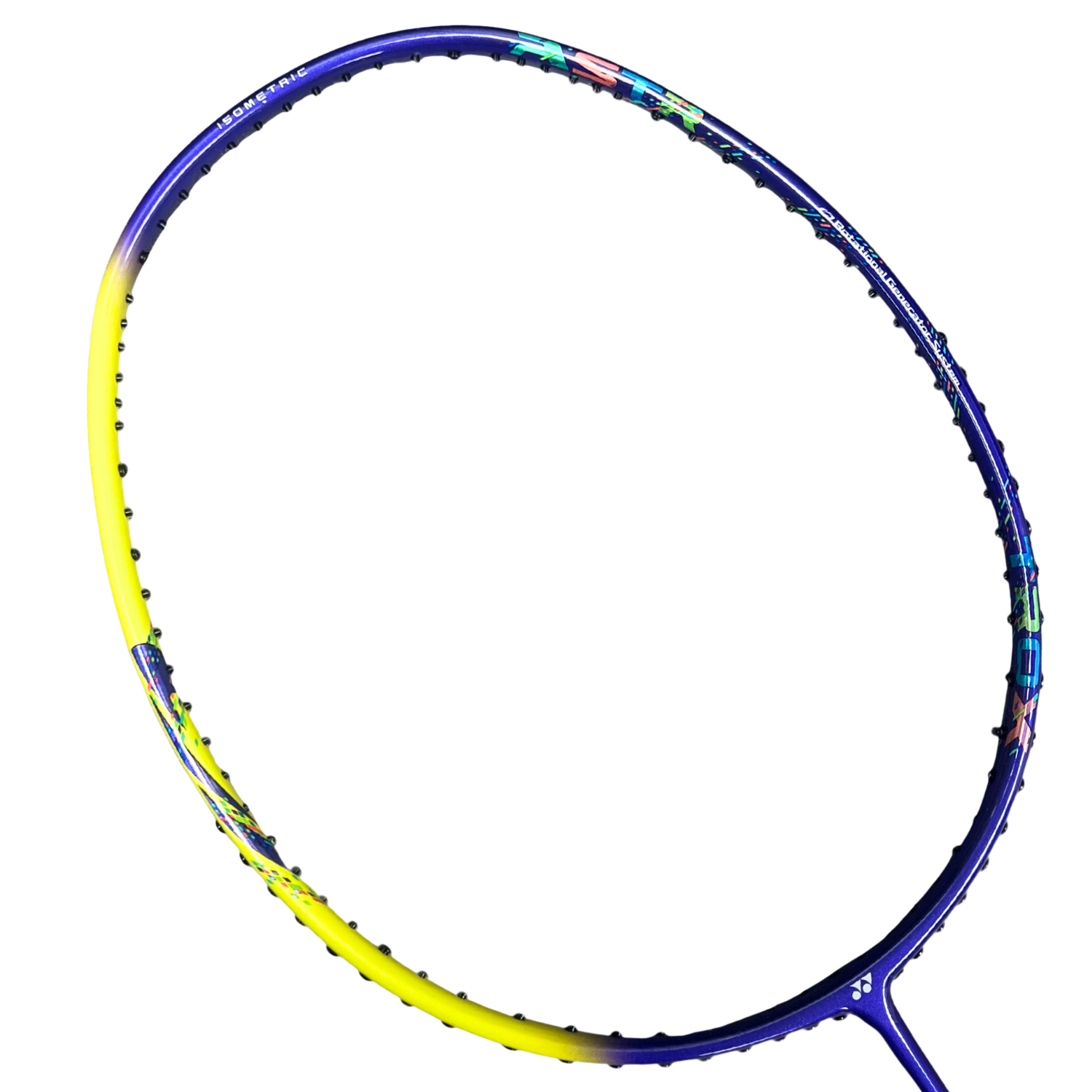
Arcsaber is the control range. Astrox is built for power, Nanoflare for speed, and Arcsaber sits deliberately between them — an even-balance frame designed to hold the shuttle on the strings a fraction longer and put it exactly where you meant to.
It is the smallest of the three Yonex families and the easiest to explain. Central Sports is the official retailer of the Yonex All England Championships, and most Arcsaber frames come with a free restring to your chosen tension.
The tier system
Arcsaber uses the same four tiers as the rest of the range:
- Play — entry level, pre-strung, forgiving.
- Game — a step up in materials and stiffness.
- Tour — near-Pro feel at a lower price. Usually the best value.
- Pro — full specification, stiffest shaft, least forgiving.
The Arcsaber range, model by model
Arcsaber 11 — the flagship
The frame the range is built around, and a genuine all-court racket. Even balance, a stiff shaft in the Pro version, and the most consistent feel of any Yonex frame if you value placement over raw power. The 11 Pro is the full specification, available in both 3U and 4U. The 11 Play is the entry version and one of the best-value serious rackets Yonex make — a genuinely good frame at a beginner price.
Arcsaber 7 — the accessible all-rounder
More flexible than the 11, which makes it easier to generate power without a fast swing. If you like the idea of an even-balance control racket but are not yet playing at a high level, this is the one. Available as 7 Play, 7 Tour and 7 Pro, with limited-edition colourways appearing regularly.
Arcsaber 73 Light and Arcsaber 2 Clear — entry level
Light, flexible and affordable. The 73 Light suits juniors and players returning after a break; the 2 Clear is a straightforward first racket.
Which Arcsaber should you buy?
- Complete beginner: Arcsaber 2 Clear or 73 Light.
- Improving, playing weekly: Arcsaber 7 Play or 11 Play.
- Club player who values placement: Arcsaber 7 Tour.
- County level, all-court game: Arcsaber 11 Pro or 7 Pro.
Who Arcsaber is really for
Three types of player, in our experience across the counter:
- Singles players with an all-court game who need one racket to do everything rather than specialise.
- Players who have tried both extremes — found Astrox too sluggish through the air and Nanoflare too light to hit with — and want the middle.
- Anyone still deciding what kind of player they are. An even-balance frame will not fight you while you work it out, and you will not outgrow it in a season.
The Arcsaber 11 Play in particular is the racket we hand to people who say "I don't know what I need yet". It is forgiving enough for a club player and good enough that you will not need to replace it the moment you improve.
Weights and grip sizes
Arcsaber frames come mostly in 3U (85–89g) and 4U (80–84g). 4U suits doubles and faster exchanges; 3U gives a more solid feel and suits singles. Grip sizes run G4 (larger) to G6 (smaller), with G5 the usual adult default.
Arcsaber FAQs
What is Arcsaber good for?
Control and placement. It is an even-balance range built for all-court players who want the shuttle to go exactly where they intend, rather than maximum power or maximum speed.
Arcsaber, Astrox or Nanoflare?
Astrox for power, Nanoflare for speed, Arcsaber for control and all-court play. If you are unsure which you need, Arcsaber is the safest choice.
Is the Arcsaber 11 Play worth it?
Yes — it is one of the best-value rackets in the Yonex range. You get the flagship frame shape at an entry price, with a more forgiving shaft.
What is the difference between Arcsaber 7 and 11?
The 11 is stiffer and more precise but demands better timing. The 7 is more flexible and easier to generate power with. Most club players get more from the 7.
Browse the full Yonex Arcsaber range, compare it with Astrox and Nanoflare, or see all badminton rackets. Free restringing included with most Arcsaber frames — tell us your tension at checkout.